







The bacterial growth curve describes the predictable phases that a bacterial population goes through in a closed system (batch culture) with a limited amount of nutrients. This curve is usually represented by plotting the logarithm of the number of living cells against time.
Phases of the Bacterial Growth Curve
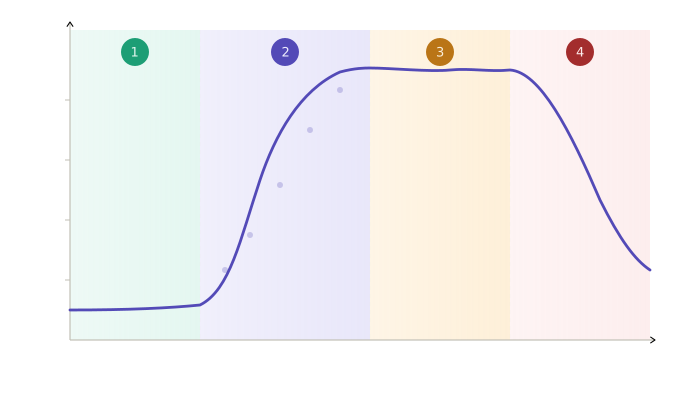
Lag Phase (Adaptation Phase)
During the lag phase, bacteria adapt to their new environment. There is metabolic activity (synthesis of RNA and enzymes) but no cell division yet. The duration depends on the condition of the cells and the specific changes in the environment.
Log Phase (Exponential Phase)
In the log phase, cells divide at a constant, maximum rate via binary fission, and the population doubles with every generation. This is the phase where bacteria are most sensitive to antibiotics.
Stationary Phase (Equilibrium Phase)
During the stationary phase, growth levels off as nutrients are depleted and waste products accumulate. The number of new cells equals the number of dying cells, keeping the population size stable. Some bacteria form endospores during this phase to survive unfavorable conditions.
Death Phase (Decline Phase)
In the death phase, death exceeds reproduction due to a lack of food and toxic accumulation. The number of viable cells decreases exponentially.
Key Factors and Measurements
Temperature, pH, and the availability of oxygen and nutrients determine the growth rate and the duration of each phase. In the laboratory, growth is often measured via Optical Density (OD) using a spectrophotometer (turbidity) or by counting Colony Forming Units (CFU) on an agar plate. Knowledge of the growth curve is essential for food safety (predicting spoilage), industry (optimizing fermentation), and medicine (antibiotic research).
resource: Lab Lexicon Bacterial Growth calculator


