







In short, Polymerase Chain Reaction (PCR) is a laboratory technique used to make millions of copies of a specific DNA segment. Scientists often need to study DNA, but biological samples (like a drop of blood or a swab from a cheek) usually contain a very tiny amount of genetic material, too little to see or analyze directly. PCR solves this “needle in a haystack” problem by amplifying the DNA until there is a large enough quantity to work with.
How PCR Works: The Three-Step Cycle
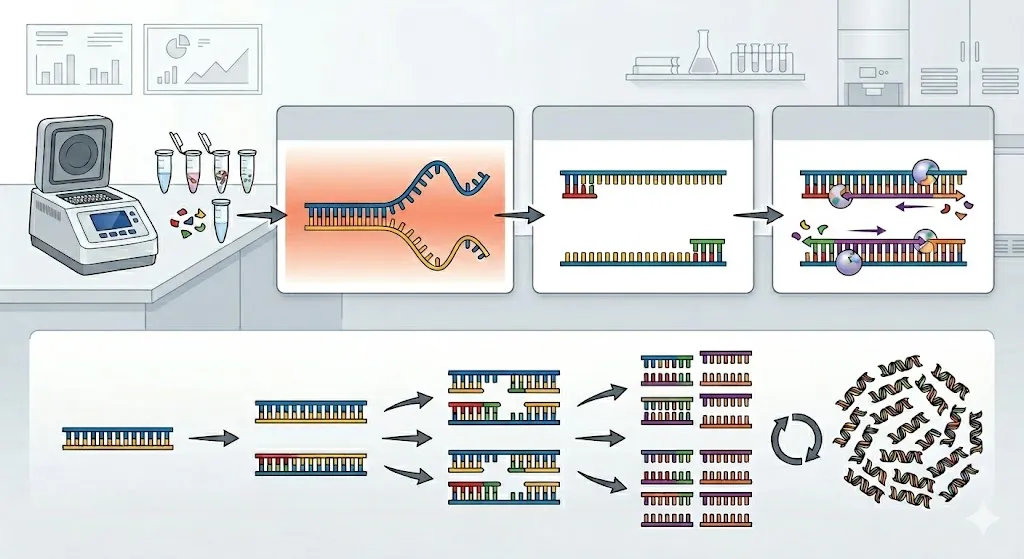
PCR doesn’t require complex machinery to “cut and paste” DNA; instead, it uses temperature changes to control the reaction. The process happens inside a thermal cycler and repeats roughly 25 to 40 times.
- Denaturation (The “Unzip”)
The reaction mixture is heated to approximately 95°C. At this high temperature, the hydrogen bonds holding the two strands of the DNA double helix together break, causing the DNA to separate into two single strands.
- Annealing (The “Prime”)
The temperature is lowered to between 50°C and 65°C. This allows short pieces of custom-built DNA called primers to bind (anneal) to the specific target sequences on the single-stranded DNA. These primers act as “bookmarks,” telling the enzyme exactly where to start copying.
- Extension (The “Build”)
The temperature is raised to about 72°C. An enzyme called Taq polymerase (a heat-stable DNA polymerase) grabs onto the primers and begins adding nucleotides to the strand. It builds a new complementary strand of DNA, effectively doubling the amount of target DNA.
Practical PCR Protocol and Troubleshooting
Set up a 25 µL reaction on ice: 12.5 µL of 2× PCR master mix (containing Taq polymerase, dNTPs, MgCl2, and buffer), 0.5 µL each of forward and reverse primers (10 µM stock, final concentration 0.2 µM), 1–100 ng of template DNA, and nuclease-free water to 25 µL. Design primers with 18–24 nucleotides, 40–60% GC content, and a melting temperature of 55–65°C. The optimal annealing temperature (Ta) is 3–5°C below the primer Tm; run a gradient from 50°C to 65°C to determine the best Ta. Avoid primers with 3’ GC clamps longer than 3 bases, runs of same nucleotide longer than 4, or predicted hairpin structures. Amplify using an initial denaturation at 95°C for 3 minutes, followed by 30–35 cycles of 95°C for 30 seconds, Ta for 30 seconds, and 72°C for 30–60 seconds per kb of target, with a final extension at 72°C for 5 minutes. If no product is obtained, increase template amount, reduce Ta by 2–5°C, or add DMSO (2–5%) for GC-rich templates. For nonspecific bands, increase Ta, reduce MgCl2 to 1.5 mM, or decrease primer concentration. If smearing occurs, reduce cycle number or template amount. Analyze 5 µL of product by agarose gel electrophoresis with a DNA ladder for size confirmation.
For applications requiring constant-temperature amplification, isothermal amplification methods such as LAMP provide an alternative to thermal cycling.
Real-World Application
In genotyping a human SNP (rs1800497), PCR with allele-specific primers amplifies a 320 bp product from genomic DNA extracted from buccal swabs. An annealing temperature gradient identifies 60°C as optimal. After 35 cycles, gel electrophoresis shows a single clean band in all samples. The product is Sanger sequenced to confirm the Taq1A polymorphism, demonstrating the importance of primer design and thermal optimization for reproducible genotyping.
resource: Lab Lexicon Oligo Tm Calculator